

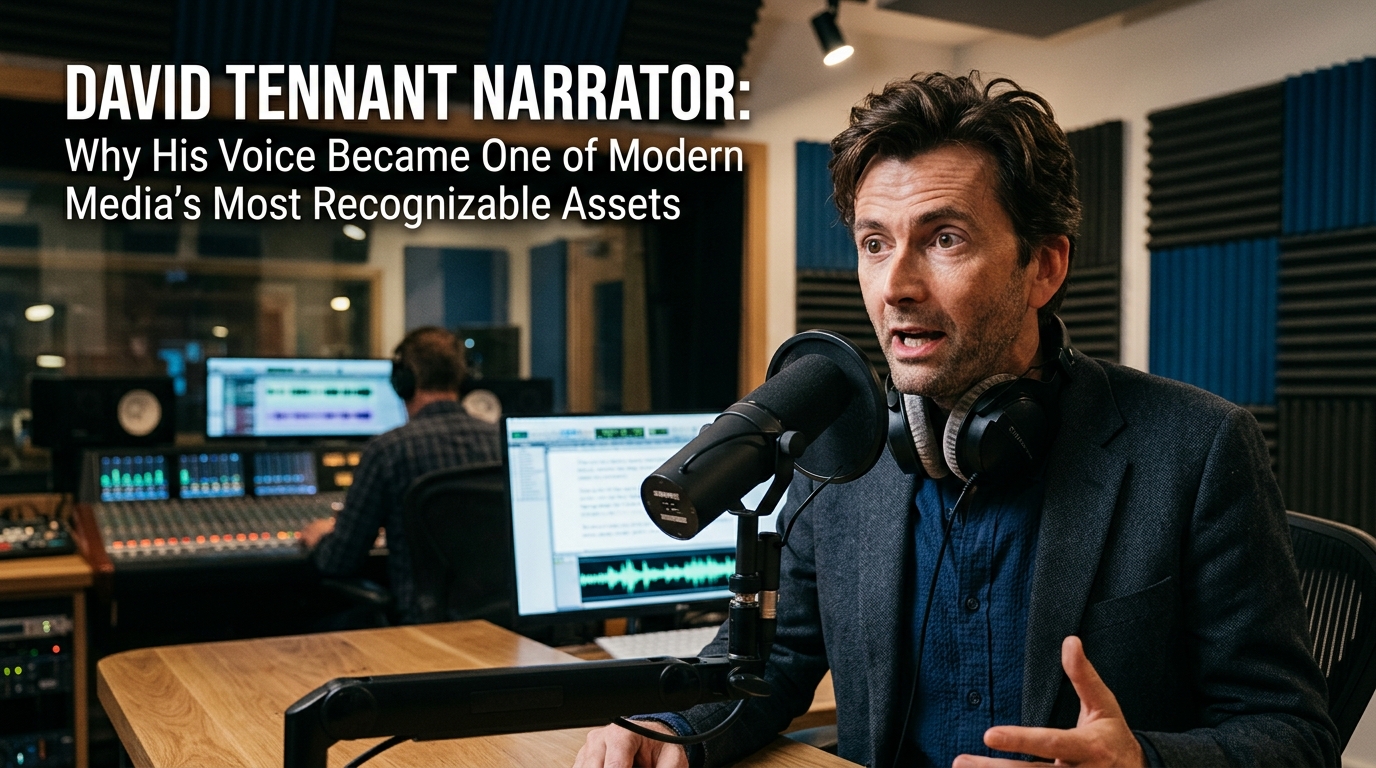
There are certain voices audiences recognize instantly, even before identifying the face behind them. A single sentence can trigger nostalgia, authority, warmth, or excitement. In an era dominated by visual media and endless digital content, the enduring popularity of the David Tennant narrator phenomenon proves that voice remains one of storytelling’s most powerful tools.
Whether guiding viewers through documentaries, bringing audiobooks to life, or delivering sharp wit in fantasy dramas, David Tennant has built a reputation that extends far beyond traditional acting. While many know him from Doctor Who or Good Omens, his work as a narrator has quietly become one of the defining aspects of his career.
This evolution reflects something larger happening across entertainment and media. Audiences increasingly consume stories through podcasts, audiobooks, streaming documentaries, and voice-driven experiences. As attention spans fragment and multitasking becomes the norm, narration has transformed from a supporting craft into a central form of modern storytelling.
For media professionals, entrepreneurs, and technology-focused audiences, the rise of David Tennant as a narrator offers insight into how voice, personality, and emotional delivery shape audience trust in the digital age.
The Power of Voice in Modern Storytelling
Long before streaming platforms and smartphones, human civilization relied on spoken storytelling. Oral traditions shaped cultures, preserved history, and connected communities through emotion and performance.
Modern narration continues that tradition in updated form.
The popularity of the David Tennant narrator identity demonstrates how audiences still respond deeply to vocal presence. A narrator does more than read words aloud. They create atmosphere, rhythm, tension, and emotional intimacy.
This matters more today because media consumption habits have changed dramatically. People now listen while commuting, exercising, working remotely, or multitasking throughout the day. Audio storytelling fits seamlessly into modern routines.
As a result, narration has become both an entertainment product and an emotional companion.
Tennant’s success in this space comes partly from his ability to balance theatrical energy with conversational accessibility. His performances feel polished without sounding distant, expressive without becoming overwhelming.
That balance is difficult to achieve and increasingly valuable in audio-first media environments.
How David Tennant Built His Reputation as a Narrator
Although David Tennant first gained international recognition through acting, narration became a natural extension of his strengths as a performer.
His vocal range allows him to move between genres effortlessly. He can sound playful, intense, scholarly, vulnerable, or commanding depending on the material. This adaptability has made him especially effective across audiobooks, documentaries, animation, and scripted audio productions.
Importantly, Tennant approaches narration as performance rather than technical delivery.
Many narrators simply read text clearly. Tennant interprets it. He creates pacing, emotional texture, and distinct vocal identities that keep listeners engaged over long-form content.
This approach aligns with broader trends in entertainment where audiences increasingly value immersive experiences over passive consumption.
In audiobooks especially, listeners often choose narrators as carefully as they choose authors. A compelling voice can significantly shape how audiences experience a story.
The success of the David Tennant narrator brand reflects that evolving audience expectation.
Audiobooks and the Rise of Voice-Led Entertainment
The audiobook industry has expanded rapidly over the past decade, transforming narration into a major entertainment category rather than a niche publishing format.
Several factors explain this growth:
busy lifestyles,
screen fatigue,
podcast culture,
and the normalization of audio-based learning and entertainment.
Within this landscape, recognizable narrators have become commercially influential. Audiences frequently search for books narrated by specific performers because vocal delivery affects immersion and emotional connection.
David Tennant’s narration work stands out because he combines celebrity recognition with genuine vocal craftsmanship. Some actors transition into narration unsuccessfully because they rely too heavily on star power. Tennant succeeds because his narration functions independently of his visual identity.
Listeners trust his ability to guide stories effectively.
This trust is increasingly important in crowded digital marketplaces where consumers face endless content options.
Why Certain Narrators Build Loyal Audiences
Narration operates differently from traditional acting because the audience experience is more intimate. Listeners often consume narrated content alone, through headphones, over extended periods of time.
This creates a uniquely personal relationship between narrator and audience.
The David Tennant narrator phenomenon reflects how vocal familiarity builds emotional comfort. Over time, audiences associate specific voices with reliability, quality, and emotional tone.
This dynamic resembles modern creator culture in many ways. Podcasts, livestreams, and audio content have shifted entertainment toward personality-driven engagement rather than purely studio-driven production.
Narrators who cultivate recognizable vocal identities benefit from this shift.
Tennant’s voice combines several characteristics that audiences consistently respond to:
clarity,
expressiveness,
warmth,
humor,
and emotional flexibility.
These qualities allow him to navigate multiple storytelling styles without losing authenticity.
Narration as a Business Asset in the Streaming Era
Voice has become increasingly valuable in the digital economy.
Streaming platforms, podcast networks, audiobook services, gaming companies, and AI-driven media businesses all compete for audience attention in highly saturated environments. Strong narration helps differentiate content in a crowded marketplace.
This trend explains why recognizable narrators now function as strategic business assets rather than interchangeable production roles.
| Traditional Media Era | Audio-Driven Digital Era |
|---|---|
| Visual celebrity dominance | Voice personality importance |
| Limited audiobook audiences | Mainstream audio consumption |
| Narration as secondary craft | Narration as premium experience |
| Radio-focused voice work | Multi-platform voice ecosystems |
| Passive listening habits | Immersive audio engagement |
The table highlights how audio storytelling has evolved into a major media sector.
For entrepreneurs and technology leaders, this transformation demonstrates the growing importance of emotional communication in digital products. Whether through podcasts, AI voice interfaces, or branded content, vocal identity increasingly shapes user trust and engagement.
The Emotional Intelligence Behind Great Narration
One reason David Tennant remains effective as a narrator is his emotional precision. Strong narration requires more than dramatic energy; it requires restraint and emotional timing.
Listeners quickly disengage from performances that feel exaggerated or artificial.
Tennant’s narration style often succeeds because it respects audience intelligence. He allows emotional moments to breathe naturally rather than forcing intensity. This creates a listening experience that feels immersive rather than performative.
Emotional intelligence has become especially valuable in modern media because audiences increasingly reject overly polished or emotionally manipulative content.
People want authenticity—even in fiction.
This expectation extends beyond entertainment. Brands, executives, and digital creators now compete partly on emotional credibility. Audiences respond more strongly to communication that feels human rather than corporate.
The popularity of trusted narrators reflects this broader cultural movement toward emotionally grounded communication.
The Connection Between Narration and Technology
The future of narration sits at an interesting intersection between human creativity and technological innovation.
Artificial intelligence can now replicate voices, generate synthetic speech, and automate basic narration tasks. Yet audiences continue gravitating toward human narrators for emotionally rich storytelling experiences.
This distinction matters.
Technology can imitate pronunciation and pacing, but emotional nuance remains significantly harder to replicate authentically. Human narrators bring interpretation, unpredictability, and lived emotional understanding into performances.
The continuing demand for figures like David Tennant highlights the enduring value of human-centered storytelling in increasingly automated environments.
At the same time, technology is expanding opportunities for narrators. Streaming platforms, interactive audio experiences, gaming environments, and immersive storytelling formats all create new spaces for voice performance.
Narration is no longer confined to books or documentaries. It has become integrated into broader digital ecosystems.
Why Audiences Continue Returning to Familiar Voices
In a fragmented media landscape, familiarity itself has become valuable.
Modern audiences encounter overwhelming amounts of content daily. Trusted narrators provide consistency amid that noise. Their voices act almost like emotional anchors, helping audiences relax into stories more quickly.
This psychological dynamic explains why listeners often develop strong loyalty toward narrators they admire.
The David Tennant narrator phenomenon reflects this emotional familiarity. His voice carries cultural associations built over years of television, audio work, and public visibility. Audiences bring those associations into new projects, deepening engagement before stories even begin.
For businesses and creators, this offers an important lesson about modern branding: consistency builds emotional recognition over time.
Whether through voice, design, messaging, or storytelling style, recognizable identity strengthens audience connection.
The Future of Voice-Led Media
As media consumption continues evolving, voice-driven storytelling will likely become even more influential. Podcasts, audiobooks, AI interfaces, immersive entertainment, and smart-device ecosystems all rely heavily on vocal interaction.
This shift creates new opportunities for performers who understand how to communicate emotionally through sound alone.
David Tennant’s success as a narrator illustrates that audiences still crave distinctly human storytelling experiences even as technology advances rapidly.
Voice remains one of the most emotionally direct forms of communication. It conveys personality, empathy, humor, tension, and trust in ways that visuals alone cannot fully replicate.
In many ways, the growing importance of narration reflects a broader cultural realization: people do not merely consume information. They respond to how it feels to receive it.
Conclusion: Why the David Tennant Narrator Legacy Matters
The popularity of David Tennant as a narrator represents more than admiration for a talented actor. It reflects a larger transformation in how modern audiences engage with stories.
In a digital world saturated with visuals and constant distraction, voice has re-emerged as a uniquely intimate storytelling medium. Narrators now shape emotional experiences across entertainment, publishing, technology, and media ecosystems.
Tennant’s enduring success comes from his ability to combine technical skill with emotional authenticity. His performances remind audiences that storytelling is not only about information or spectacle—it is about connection.
As audio-driven media continues expanding, voices that feel human, intelligent, and emotionally resonant will become increasingly valuable. And in that evolving landscape, the David Tennant narrator phenomenon stands as a powerful example of how timeless storytelling instincts continue adapting to modern technology.