

On a rainy Tuesday evening, a founder sat staring at a spreadsheet that told an uncomfortable truth. Hundreds of units sat in storage, unsold. Capital was frozen in inventory. Marketing experiments had failed, but the cost of failure lingered in cardboard boxes stacked against the wall. Months later, that same founder would describe the turning point simply: switching to Printely.
The move didn’t just change how products were produced. It changed how decisions were made. Instead of forecasting demand months in advance, the business became responsive. Instead of tying up cash in bulk orders, resources shifted toward branding and customer acquisition. For entrepreneurs and tech-driven founders, Printely represents more than a fulfillment partner—it signals a structural shift in commerce itself.
In a digital economy defined by agility, infrastructure matters as much as innovation.
Why Printely Reflects the Shift Toward Lean Commerce
Traditional retail models were built around prediction. Forecast demand, manufacture at scale, distribute widely. The system rewarded certainty and punished miscalculation. For startups without vast capital reserves, the risks were disproportionate.
Printely aligns with a leaner philosophy. Products are created after purchase, not before. This reverses the financial burden. Instead of absorbing production risk upfront, entrepreneurs respond to confirmed demand.
The difference is subtle but powerful. Decision-making becomes iterative. Brands can test new designs weekly rather than seasonally. Data replaces guesswork.
Lean commerce is not about cutting corners. It is about reducing unnecessary exposure.
The Technology Layer Powering Printely
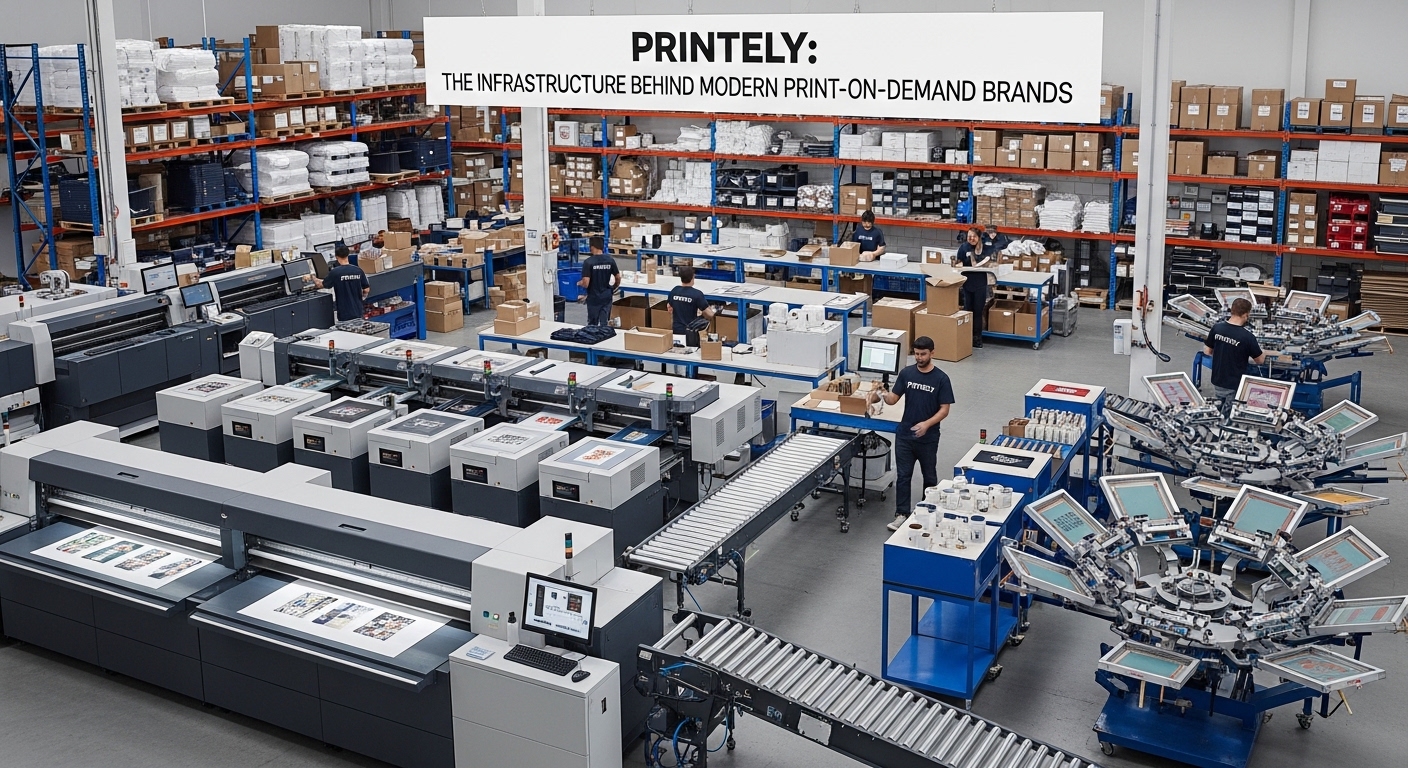
Behind the simplicity of on-demand ordering lies sophisticated integration. Printely connects ecommerce storefronts, automated production facilities, and global shipping networks into a seamless workflow.
When a customer completes a purchase, that order is transmitted instantly to a fulfillment center. Printing, packaging, and shipping occur with minimal manual intervention. Automation reduces errors while accelerating turnaround time.
For tech readers and founders, this integration is the real story. Printely operates at the intersection of software and manufacturing—two domains that historically moved at different speeds. By synchronizing them, the platform creates operational fluidity.
Infrastructure, when invisible, becomes powerful.
Printely and the Economics of Risk Reduction
One of the most transformative aspects of Printely is how it alters risk distribution. Entrepreneurs no longer need to invest heavily in bulk production. Instead, costs align directly with revenue events.
Consider how the two models compare:
| Business Factor | Traditional Bulk Printing | Printely On-Demand Model |
|---|---|---|
| Upfront Investment | High | Minimal |
| Inventory Storage | Required | Not Required |
| Product Testing | Slow and Costly | Fast and Affordable |
| Cash Flow Flexibility | Limited | Strong |
| Waste from Unsold Stock | Significant | Reduced |
| Scalability | Gradual | Elastic |
This economic realignment allows founders to allocate resources toward marketing, product development, and customer experience rather than warehousing.
Cash flow clarity fosters strategic confidence.
Creative Freedom in the Age of Customization
Modern consumers value individuality. Generic merchandise often fades into the background. Printely supports extensive customization, enabling entrepreneurs to translate digital designs into tangible goods without committing to large production runs.
This flexibility encourages creative experimentation. A founder can launch limited-edition drops, seasonal collections, or community-driven collaborations with minimal friction.
Creative freedom expands when operational constraints shrink.
For creators and digital-first brands, Printely becomes an enabler of storytelling. Merchandise evolves from commodity to narrative extension.
Scaling Without Structural Strain
Growth can overwhelm fragile systems. A viral campaign that drives sudden demand often exposes operational weaknesses. Delays and fulfillment errors erode trust quickly.
Printely’s automated framework absorbs volume fluctuations more effectively than manual processes. Because production is distributed and digitally coordinated, scaling becomes less disruptive.
For venture-backed startups or fast-growing ecommerce brands, scalability is not optional. It is survival.
Infrastructure that scales quietly supports ambition loudly.
Printely in the Creator and Startup Ecosystem
The rise of the creator economy has blurred the line between media and merchandise. Influencers, educators, and community builders increasingly monetize through branded products.
Printely integrates naturally into this environment. Creators can launch merchandise lines without inventory risk, aligning product releases with content strategies.
Startups also benefit from rapid prototyping. Conference giveaways, team apparel, and promotional campaigns can be deployed quickly, reinforcing brand presence without logistical strain.
Commerce now intersects with community.
Sustainability and Responsible Production
Environmental responsibility has become central to brand credibility. Overproduction contributes to waste, and unsold inventory often ends in landfills.
On-demand production reduces surplus by manufacturing only what is ordered. While sustainability depends on broader supply chain practices, minimizing excess inventory represents meaningful progress.
Entrepreneurs attentive to environmental impact can integrate Printely into broader sustainability narratives.
Efficiency and responsibility increasingly move together.
Data-Driven Iteration
Printely’s integration with ecommerce platforms allows founders to analyze performance in real time. Sales data reveals which designs resonate, which price points convert, and which demographics engage most actively.
This data informs iteration. High-performing products can be expanded into additional variations. Underperforming concepts can be retired quickly.
In traditional models, such adjustments required clearing unsold inventory. With Printely, iteration becomes continuous.
Data transforms creativity into strategy.
Brand Integrity and Quality Control
While flexibility and speed are critical, product quality ultimately shapes customer loyalty. Printely’s reputation depends on maintaining consistent print resolution, durable materials, and reliable shipping standards.
For founders, selecting fulfillment partners reflects directly on brand identity. Customers rarely distinguish between brand and production partner. The experience feels unified.
Maintaining quality ensures that operational convenience does not compromise perception.
Trust remains the ultimate currency.
Global Reach and Market Expansion
Digital storefronts transcend geography. Entrepreneurs increasingly serve international audiences from day one. Printely’s distributed fulfillment network supports cross-border commerce, reducing shipping times and associated costs.
Global accessibility expands opportunity. A niche design that resonates in one country can gain traction elsewhere without logistical reinvention.
Barriers to entry shrink when infrastructure supports ambition.
The Future Trajectory of Printely
As artificial intelligence and automation continue advancing, print-on-demand platforms will likely evolve further. AI-assisted design suggestions, predictive demand modeling, and supply chain optimization could enhance operational efficiency.
Printely sits within this trajectory. Its strength lies in blending technology with tangible production—a convergence that defines modern commerce.
Entrepreneurs who understand this shift gain strategic foresight. Infrastructure choices made today influence scalability tomorrow.
Adaptation remains the constant.
Conclusion: Printely as a Strategic Enabler
The founder who once faced stacks of unsold inventory now launches new collections without hesitation. The risk calculus changed. Creativity expanded. Strategic decisions became data-informed rather than speculative.
Printely represents more than a production service. It embodies a structural shift toward responsive, lean, and technology-integrated commerce.
For entrepreneurs, tech readers, and founders navigating volatile markets, the lesson is clear: operational infrastructure shapes possibility. When production aligns with demand in real time, growth becomes less about prediction and more about responsiveness.
In a landscape where agility determines survival, Printely stands as a quiet but powerful catalyst.