

The conversation started with something small. A U.S.-based founder was negotiating a manufacturing contract with a European supplier. Everything was aligned—pricing, timelines, materials—until a specification sheet caused confusion. The product weight was listed as 110 pounds. The supplier responded with a pause: “Can you confirm that in kilograms?”
In global business, even the simplest details can create friction. That is where understanding 110 pounds en kilos becomes more than a quick Google search. It becomes part of operational fluency.
For entrepreneurs, tech professionals, and founders working across borders, measurement conversion is not trivia. It is infrastructure. Precision in units ensures smooth logistics, accurate health tracking, compliant documentation, and clear communication.
So let us begin with clarity.
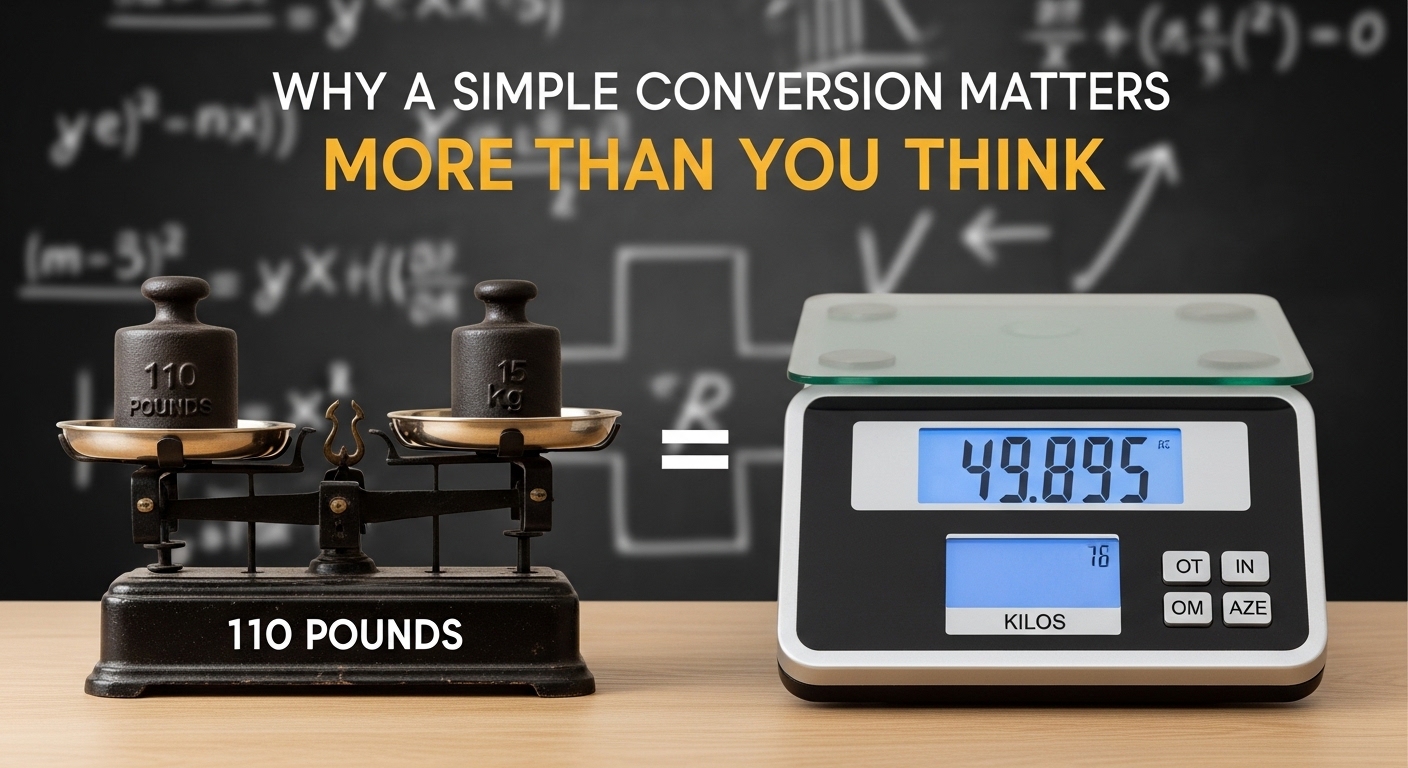
110 pounds equals approximately 49.9 kilograms.
But the real story lies beyond the number.
The Exact Conversion: Breaking Down 110 Pounds en Kilos
The mathematical relationship between pounds and kilograms is fixed and standardized internationally.
1 pound equals 0.453592 kilograms.
To convert 110 pounds into kilograms, the calculation is straightforward:
110 × 0.453592 = 49.89512 kilograms
Rounded to one decimal place, that becomes 49.9 kg.
While this is elementary arithmetic, understanding the precision behind it matters. In shipping, even slight rounding differences can affect cost tiers. In engineering, tolerance margins depend on exact figures. In health metrics, body weight calculations require consistency.
Accuracy builds trust across systems.
Why Weight Conversion Still Matters in a Digital World
It may seem surprising that in an era of AI, blockchain, and cloud computing, unit conversion remains relevant. Yet global interoperability depends on standardized measurements.
The United States primarily uses the imperial system. Most of the world operates under the metric system. This dual reality creates ongoing translation between pounds and kilograms.
For founders expanding internationally, product documentation must reflect metric standards. Investors in Europe expect financial models using kilograms where applicable. Logistics software often defaults to metric units.
The ability to seamlessly interpret values like 110 pounds en kilos signals global readiness.
From Gyms to Global Trade: Real-World Context
Consider how often weight appears in daily professional life.
A fitness startup onboarding international users must allow weight tracking in both pounds and kilograms. An e-commerce entrepreneur calculating shipping costs must convert package weights for overseas customers. A hardware founder working with Asian manufacturers must translate product specs into metric measurements.
In each scenario, 110 pounds may represent:
A customer’s body weight
A product’s shipping mass
A component’s load capacity
A luggage limit for international travel
The conversion to 49.9 kilograms ensures universal clarity.
Quick Reference Table for Contextual Understanding
To better visualize how 110 pounds compares with nearby values, the following table offers perspective:
| Pounds (lbs) | Kilograms (kg) |
|---|---|
| 100 lbs | 45.4 kg |
| 105 lbs | 47.6 kg |
| 110 lbs | 49.9 kg |
| 115 lbs | 52.2 kg |
| 120 lbs | 54.4 kg |
This comparison shows how incremental increases in pounds translate within the metric system. For professionals handling weight-sensitive calculations, these differences can influence pricing, structural limits, and compliance thresholds.
Precision prevents costly assumptions.
Health and Performance Metrics
In global health discussions, kilograms dominate. Medical research, BMI calculations, and international health standards use metric units.
For example, Body Mass Index requires weight in kilograms divided by height in meters squared. If a person weighs 110 pounds, converting to 49.9 kilograms ensures accurate computation.
Health-tech founders designing wearable devices or wellness apps must integrate automatic conversion features. User experience improves when data feels localized yet globally compatible.
Seamless conversion reduces friction.
Logistics and E-Commerce Applications
Shipping carriers often calculate international freight costs based on weight in kilograms. Customs documentation typically requires metric units.
If a product weighs 110 pounds but documentation incorrectly lists a rounded or miscalculated kilogram value, shipment delays can occur.
In high-volume operations, small miscalculations multiply quickly. A one-kilogram discrepancy across thousands of shipments impacts freight expenses.
Entrepreneurs building scalable logistics systems treat unit consistency as a non-negotiable operational standard.
Engineering and Manufacturing Precision
In engineering contexts, weight directly influences safety. Structural tolerances, load-bearing calculations, and mechanical design depend on exact mass.
If a structural component must support 110 pounds, communicating that requirement as 49.9 kilograms ensures international engineering teams operate from identical assumptions.
Even minor rounding differences may affect stress analysis models.
For hardware founders, unit clarity reinforces product integrity.
Mental Math Shortcut for Fast Conversations
While precise figures matter in documentation, quick estimation skills are valuable in meetings.
A practical shortcut: divide pounds by 2.2 to estimate kilograms.
110 ÷ 2.2 ≈ 50 kg
This approximation aligns closely with the precise 49.9 kg conversion. It is sufficiently accurate for conversational context, though formal documents should use exact calculations.
Speed plus accuracy builds confidence.
Why the Metric System Dominates Globally
The metric system’s decimal-based simplicity supports universal adoption. Scientific research, medicine, and international trade rely on it.
Kilograms integrate seamlessly into calculations involving grams, metric tons, and Newtons in physics. This consistency reduces complexity in cross-border collaboration.
Entrepreneurs operating globally benefit from internalizing metric literacy, even if domestic markets primarily use pounds.
The future is standardized.
Common Conversion Mistakes to Avoid
Despite simplicity, errors occur frequently.
Common mistakes include:
Using incorrect conversion factors
Rounding prematurely
Confusing kilograms with grams
Failing to update all documentation after conversion
Professional environments demand vigilance. Double-checking figures safeguards credibility.
Technology’s Role in Automatic Conversion
Modern software tools eliminate much of the manual burden. E-commerce platforms, health apps, and logistics dashboards automatically convert units based on user settings.
Yet founders must verify backend accuracy. Automated systems rely on correct programming constants.
Trust but verify.
The Broader Lesson Behind 110 Pounds en Kilos
At first glance, converting 110 pounds to kilograms seems insignificant. Yet it symbolizes something larger.
Entrepreneurship thrives on attention to detail. Small operational gaps become large-scale inefficiencies. Clear communication prevents misunderstanding.
Measurement literacy reflects global competence.
Understanding weight conversion signals readiness for cross-border collaboration, international partnerships, and global scale.
Conclusion: Precision as Professional Currency
The European supplier did not ask for kilograms to complicate the conversation. They asked for clarity.
When the founder responded confidently—“110 pounds equals 49.9 kilograms”—the meeting moved forward smoothly. The deal progressed without friction.
That moment illustrates a broader principle. Precision builds trust. Even in seemingly minor details, accuracy reinforces professionalism.
In a world where businesses span continents, mastering conversions like 110 pounds en kilos is not about mathematics alone. It is about operating fluently in a global system.
And fluency, in business, is currency.